

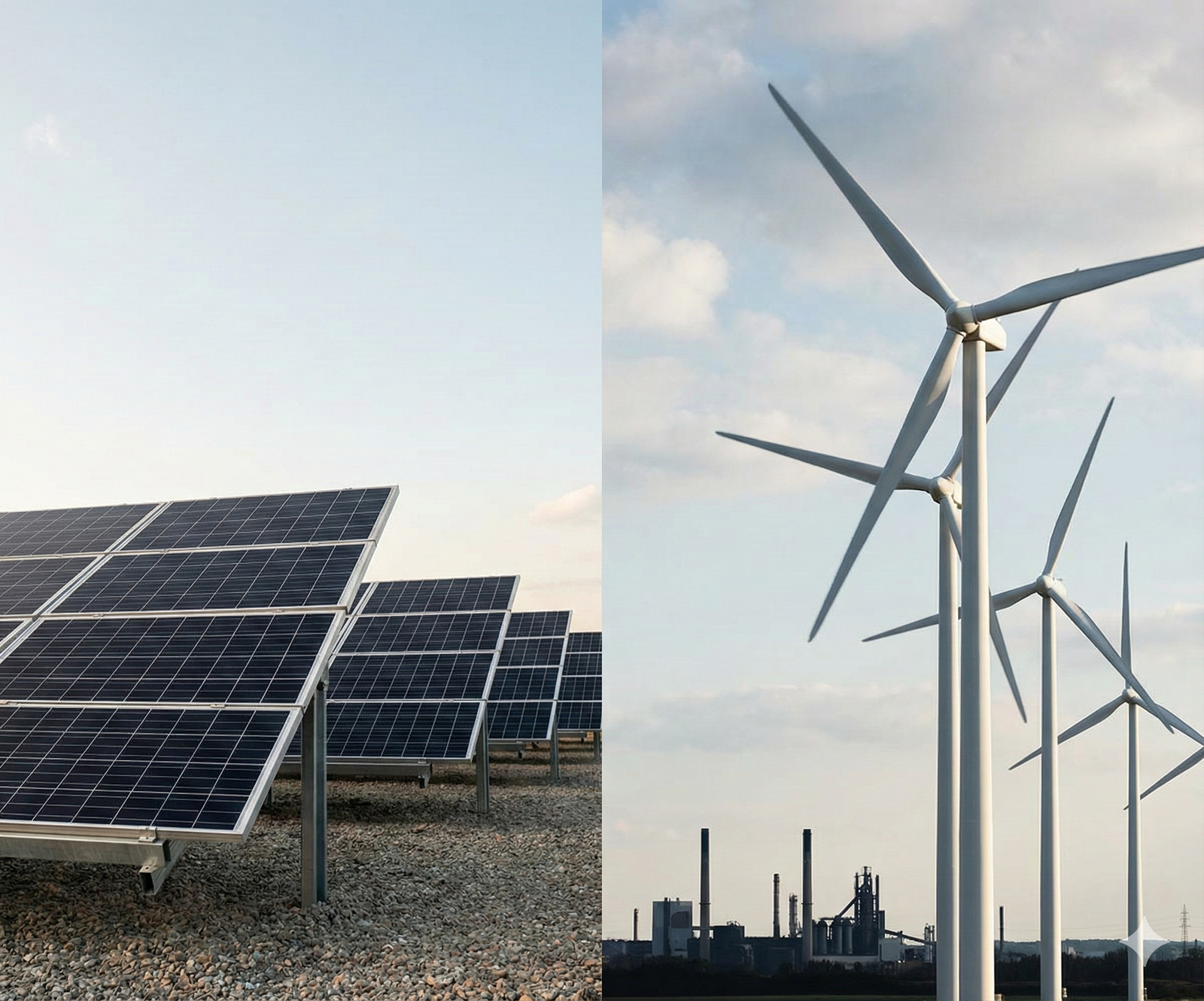
Solar vs Wind Energy:
Industrial power requirements are very different from residential electricity needs. Industries demand high reliability, predictable energy supply, stable voltage, and the ability to scale consumption with business growth. With rising electricity tariffs and increasing sustainability mandates, many businesses are shifting toward renewable energy—primarily solar and wind—to reduce long-term energy cost and carbon footprint.
But the most common question decision-makers ask is:
Solar vs Wind Energy—Which is better for industrial power projects?
The answer depends on site conditions, consumption profile, grid rules, project scale, and commercial feasibility. In this article, we’ll compare solar and wind across all key factors so you can select the right renewable strategy for your factory, plant, warehouse, or industrial campus.
1) Understanding Industrial Power Projects
Industrial projects typically require:
- High daily energy consumption (kWh)
- Peak demand management (kVA/kW)
- Stable supply for machinery and production lines
- Minimum downtime / uninterrupted operations
- Long-term energy predictability for cost planning
Because renewables are intermittent by nature, selection must consider availability, generation profile, grid integration, and financial structure.
2) Solar Energy for Industrial Use: Key Advantages
Solar energy is the most popular renewable choice for industries because it is:
- Easy to deploy
- Highly scalable
- Suitable for rooftop and ground-mounted setups
- Predictable during daytime
✅ Advantages of Solar for Industries
1. Fast Implementation
Solar projects (especially rooftops) can be completed quickly compared to wind.
2. Predictable Generation Curve
Solar output follows sunlight availability and is easy to forecast.
3. Ideal for Daytime Load
Many industries run heavy operations during daytime—solar directly offsets this.
4. Lower Maintenance
Solar has no moving parts, so long-term O&M is simpler and cost-effective.
5. Works in Most Locations
Solar is feasible almost everywhere as long as the site has good irradiation.
⚠️ Limitations of Solar
- Zero generation at night
- Reduced output on cloudy days
- Requires space (roof/land)
- Performance depends heavily on quality installation + cleaning
3) Wind Energy for Industrial Use: Key Advantages
Wind energy is especially powerful when:
- wind speeds are stable
- land availability exists
- the project is utility-scale or open access based
✅ Advantages of Wind for Industries
1. Higher Capacity Utilization
Wind can generate power day and night depending on wind patterns.
2. Better for Base Load Support
Wind can support industries needing longer operating hours.
3. Strong for Large-Scale Captive/Open Access
Wind projects can serve multiple industrial units through open access frameworks.
4. Often Stronger Output in Certain Seasons
In many regions, wind peaks during monsoon months when solar may reduce.
⚠️ Limitations of Wind
- Requires good wind resource (not suitable everywhere)
- Heavy logistics and approvals
- Higher complexity in erection and maintenance
- Needs larger land / turbine siting feasibility
4) Solar vs Wind: Comparison Table (Industrial Perspective)
Solar Energy
- Best For: Daytime loads, rooftop/ground setups
- Installation Time: Faster
- Maintenance: Low
- Site Dependence: Moderate
- Output Pattern: Daytime only
- Scalability: Very high
- Complexity: Low to medium
Wind Energy
- Best For: Longer operating hours, large-scale power requirement
- Installation Time: Longer
- Maintenance: Medium to high
- Site Dependence: High (wind must be strong)
- Output Pattern: Day + night possible
- Scalability: High but location dependent
- Complexity: Medium to high
5) Which is More Reliable for Industries?
Reliability doesn’t just mean “generation”—it means:
- predictable output
- low downtime
- stable grid integration
- minimal failure risk
✅ Solar Reliability
Solar is generally more reliable in terms of:
- predictable daily generation
- low mechanical failure (no moving parts)
✅ Wind Reliability
Wind can provide longer duration generation but reliability depends on:
- turbine technology
- service availability
- wind pattern stability
Conclusion: For most industries, solar provides more predictable reliability, while wind provides longer duration generation where feasible.
6) Cost Comparison: Solar vs Wind (Industrial Projects)
Costs vary by region and project type, but trends are clear:
✅ Solar Cost Structure
- Lower capex per MW (generally)
- Minimal heavy equipment logistics
- O&M low
✅ Wind Cost Structure
- Higher initial capex due to:
- turbines
- foundations
- cranes/logistics
- grid evacuation costs
- O&M higher due to mechanical components
However, wind may deliver better annual energy output in wind-rich zones.
7) Best Option Based on Industrial Use Case
✅ Case 1: Factory with Heavy Day Shift Production
Best Choice: Solar
Why:
- aligns with daytime load
- maximum direct offset without storage
- easier rooftop/ground setup
✅ Case 2: Industry Operating 24×7
Best Choice: Wind or Hybrid
Why:
- night-time generation possible
- reduces dependency on grid at all hours
- better for round-the-clock consumption
✅ Case 3: Industrial Cluster / Multiple Units
Best Choice: Wind / Open Access
Why:
- large-scale generation can be shared
- stronger feasibility with evacuation infrastructure
✅ Case 4: Limited Land / Only Building Space
Best Choice: Rooftop Solar
Why:
- wind needs turbine space and micro-siting distance
- rooftop solar uses existing infrastructure
8) Solar + Wind Hybrid: The Best of Both (Trending Solution)
For many industries, the real answer is not solar vs wind—but:
✅ Solar + Wind Hybrid
A hybrid approach offers:
- solar generation during day
- wind support during evenings/night
- reduced seasonal variation
- higher overall plant utilization
Add Battery Storage (Optional)
Battery helps:
- peak shaving
- backup for critical loads
- improved stability during grid fluctuations
Hybrid systems are increasingly preferred for industrial clients because they provide:
✅ higher energy continuity
✅ better annual output profile
✅ stronger savings stability
9) Decision Checklist: How to Choose Correctly
Use this checklist:
Choose Solar if:
- you run mostly daytime
- rooftop space is available
- quick execution required
- you want low-maintenance solution
Choose Wind if:
- wind resource is strong in your region
- you have larger load requirement
- you need longer-hour generation
- open access feasibility is available
Choose Hybrid if:
- your industry operates 18–24 hours
- you want stable year-round savings
- you want lower renewable intermittency risk
10) Final Verdict: Which is Better for Industrial Power Projects?
There is no one universal winner. But here’s the practical verdict:
✅ Solar is best for most industrial power users due to simplicity, scalability, predictable output, and easy implementation.
✅ Wind is best where wind resources are strong and demand is high, especially for 24×7 energy strategies.
✅ Hybrid (Solar + Wind) is the most future-ready model, especially for industries aiming for stable renewable output and better energy security.
Conclusion
Choosing between solar and wind is a strategic business decision, not just an energy decision. The right solution depends on your load pattern, site condition, grid feasibility, budget, and long-term cost goals.
If your goal is reliable savings with fast deployment, solar is usually the first step. If you want longer duration renewable generation and your location supports it, wind becomes a powerful addition. And for long-term industrial energy planning, solar + wind hybrid is increasingly becoming the gold standard.