

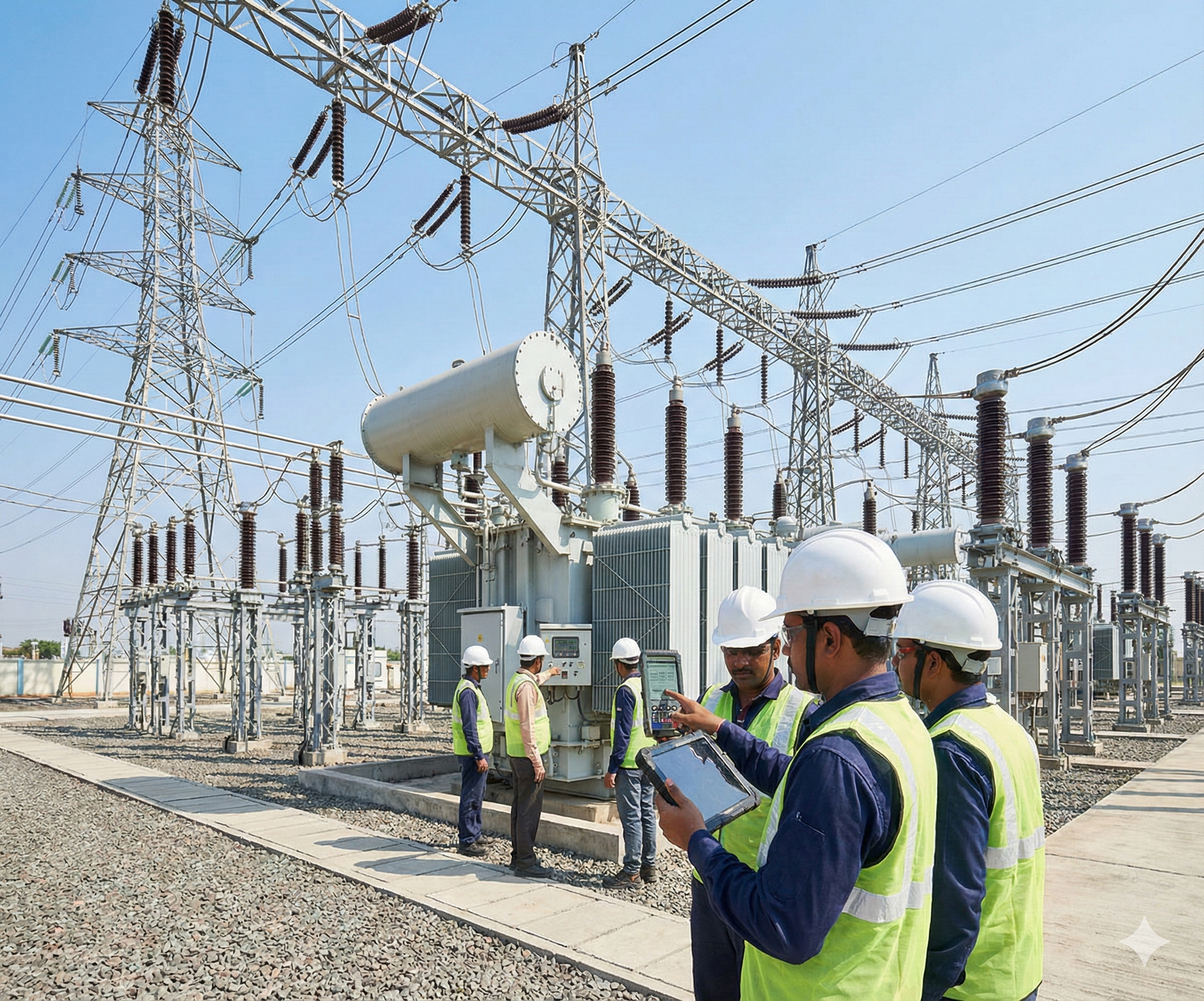
With Safety, Checklist, Timeline & Cost Factors
Electricity grids and substations are the backbone of every power system—whether it’s conventional generation or renewable energy like solar and wind. Even if power is being generated, it becomes useless without a reliable network of transmission lines, substations, protection systems, and grid synchronization.
This article provides a deep and practical guide to:
- what an electricity grid is
- how substations work
- key components
- step-by-step process from design to commissioning
- safety practices
- project checklists
- timeline and cost drivers
- FAQs
1) Understanding Electricity Grid Infrastructure
An electricity grid is a system used to:
- transmit power from generation sources
- distribute power to industrial, commercial, and residential consumers
- balance demand and supply continuously
1.1 Grid Levels (Voltage Categories)
Grid infrastructure is generally divided into:
- Transmission Grid: 220kV / 132kV / 110kV / 400kV
- Sub-Transmission: 66kV / 33kV
- Distribution: 11kV / 415V
The higher the voltage, the more efficiently power travels over long distances.
1.2 Grid Stability Requirements
Modern grids must handle:
- voltage fluctuations
- reactive power compensation
- harmonic distortions
- protection coordination
- fast fault detection and isolation
2) What Is a Substation? (And Why It Matters)
A substation is a controlled facility that:
- steps voltage up/down
- connects multiple feeders
- controls circuit switching
- isolates faults
- measures energy flow
- provides protection and automation control
2.1 Types of Substations
Common types:
- AIS (Air Insulated Substation)
- GIS (Gas Insulated Substation)
- Hybrid Substation
- Collector Substation (for renewables)
2.2 Substation Voltage Levels
Substations are built based on:
- evacuation requirements
- grid connection points
- power capacity targets
Example:
- renewable plant: 33kV collector → 132kV or 220kV evacuation substation
3) Key Components in Grid & Substation Projects
3.1 Power Transformers
Used for voltage conversion.
- 33/132kV transformer
- 66/220kV transformer
Key factors:
- MVA rating
- impedance
- cooling type
- protection (Buchholz, PRV etc.)
3.2 Switchgear & Circuit Breakers
Purpose:
- switching operations
- fault interruption
- system isolation
Types:
- vacuum circuit breakers
- SF6 breakers
- isolators and earthing switches
3.3 Busbars
Busbars distribute power within substation bays.
3.4 Protection Relays
These protect equipment by detecting faults:
- overcurrent
- earth fault
- differential fault
- distance protection
- over/under voltage
3.5 CT/PT and Metering
CT = current transformer
PT = potential transformer
Used for:
- measurement
- protection
- billing accuracy
3.6 Control Room & SCADA
SCADA enables:
- monitoring
- remote operations
- fault detection alerts
- historical data reporting
4) Step-by-Step Process: Electricity Grid & Substation Execution
Step 1 — Planning & Load Assessment
Before design begins:
- expected power demand and load growth
- energy evacuation requirements
- grid availability analysis
Deliverables:
- project scope definition
- load flow study
- single line draft
Step 2 — Detailed Engineering & Design
This phase converts scope into technical engineering.
2.1 Electrical Design Deliverables
- SLD (Single Line Diagram)
- layout drawings
- cable routing drawings
- earthing drawings
- protection scheme
2.2 Protection Studies
Critical studies include:
- relay coordination study
- short circuit study
- load flow study
Step 3 — Procurement & Logistics
Equipment procurement typically includes:
- transformers
- breakers
- relays
- panels
- CT/PT
- insulators
- cables
- structures
Large equipment requires:
- heavy transport planning
- crane unloading
- storage preparation
Step 4 — Civil Works & Foundations
Includes:
- control room building
- transformer foundation
- cable trenches
- drainage
- fencing and security
Transformer foundations require:
- oil pit and fire safety setup
- vibration and weight considerations
Step 5 — Equipment Installation (Mechanical & Electrical)
5.1 Transformer Installation
Steps:
- placement on foundation
- bushing installation
- oil filling and filtration
- testing readiness
5.2 Switchyard Installation
Includes:
- breakers
- isolators
- CT/PT installation
- busbar assembly
5.3 Panel & Control Room Setup
Includes:
- protection panels
- RTU/SCADA panel
- metering panels
Step 6 — Cabling, Earthing & Lightning Protection
6.1 Cable Laying
- trenches preparation
- cable laying and dressing
- jointing
- termination
6.2 Earthing System
Earthing ensures:
- personnel safety
- equipment reliability
- fault current dissipation
Includes:
- earth pits
- GI strip network
- earth resistance testing
6.3 Lightning Protection
- surge arresters
- shielding wire
- lightning mast
Step 7 — Testing, Pre-Commissioning & Commissioning
Testing ensures equipment works safely.
7.1 Key Tests
- IR testing
- breaker timing test
- transformer ratio test (TTR)
- relay testing
- CT polarity check
- protection functional tests
7.2 Trial Energization
Once tests pass:
- controlled energization begins
- protection logic verified
- synchronization checks completed
Step 8 — Handover & Documentation
Deliverables include:
- commissioning report
- as-built drawings
- test certificates
- relay settings sheet
- operations manual
✅ Checklists for Grid & Substation Projects
A) Engineering Checklist
- approved SLD available
- short circuit study done
- relay coordination completed
- layout and earthing drawings approved
B) Installation Checklist
- transformer placement verified
- busbar torque check done
- cable termination checked
- earthing connections complete
C) Safety & Compliance Checklist
- LOTO procedure active
- PPE compliance monitored
- fire safety systems ready
- emergency plan posted
D) Commissioning Checklist
- all tests passed
- relay settings uploaded
- SCADA connected
- energization approval received
✅ Safety Points (Substation Safety is Non-Negotiable)
Substations are high-risk due to high voltage.
Key safety risks:
- arc flash
- electrocution
- induced voltage
- fall hazards
- heavy equipment lifting
Mandatory safety practices:
✅ LOTO (Lock-out Tag-out)
✅ Electrical permit to work
✅ Arc-flash rated PPE
✅ Insulated tools
✅ Earthing before work
✅ No live work policy
✅ Emergency shutdown plan
✅ Fire safety & oil spill containment
✅ Timeline for Grid & Substation Project
Typical timelines vary with capacity.
Example timeline (indicative):
- Engineering & Studies: 3–6 weeks
- Procurement: 8–20 weeks
- Civil Works: 6–12 weeks
- Installation: 6–10 weeks
- Testing & Commissioning: 3–6 weeks
Total: 4 to 8 months (average), can vary by grid approvals.
✅ Cost Factors (What Impacts Budget the Most?)
Main cost drivers:
- Voltage level (33kV vs 132kV vs 220kV)
- Transformer MVA rating
- Breaker & switchgear type (GIS costs more than AIS)
- Transmission line length
- Protection system complexity
- Civil infra & control room scope
- Cable length and spec
- Testing and compliance requirements
✅ FAQs
Q1. What is the difference between transmission and distribution?
Transmission moves power long distance at high voltage. Distribution supplies power locally.
Q2. Which is better—GIS or AIS substation?
GIS is compact and safer in limited space but costs more. AIS is economical but needs larger land.
Q3. Why are protection relays important?
They detect faults and isolate sections quickly to prevent major damage.
Q4. What delays substation commissioning most?
Grid permissions, bay approval delays, and incomplete relay coordination/testing.
Q5. What is required before energization?
All pre-commissioning tests, safety compliance, and final approval from grid authority.
Conclusion
Electricity grid and substation projects are the foundation of a stable power ecosystem. With renewable growth, substations and grid infrastructure are becoming more intelligent, more regulated, and more performance-driven. A well-executed grid and substation setup ensures safety, reliability, and long-term power stability—making it critical for every energy project.