

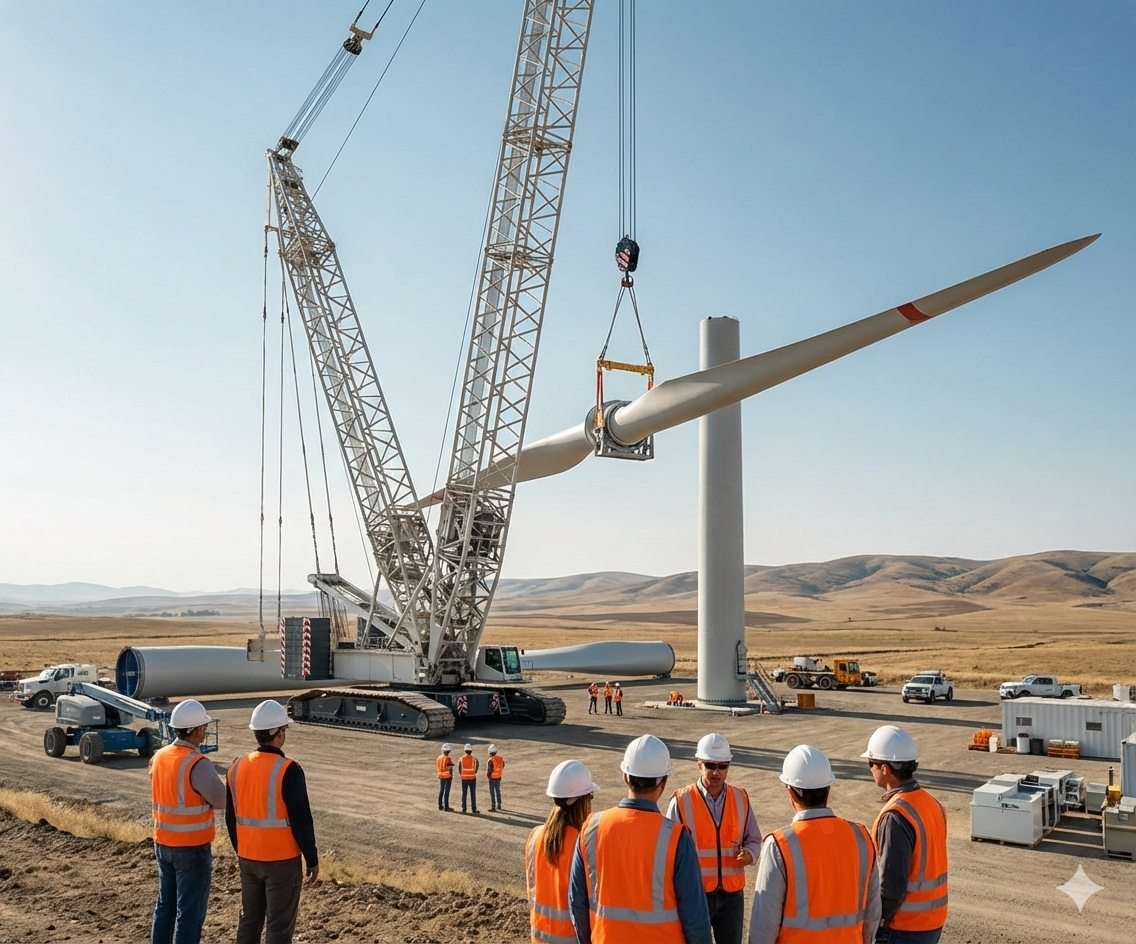
Introduction
Wind energy is one of the fastest-growing renewable power sources globally. But setting up a wind turbine isn’t just “installing a tower”—it is a complex engineering and execution process involving wind assessment, civil design, heavy logistics, high-voltage electrical infrastructure, grid compliance, strict safety standards, and final performance verification.
This guide breaks down the complete wind turbine installation process step-by-step, from site survey to commissioning, and includes checklists, safety requirements, timeline, cost factors, and FAQs.
1) Wind Turbine Installation Overview (What the Process Includes)
A wind project generally includes:
- Wind resource study & feasibility
- Land selection and turbine micro-siting
- Detailed engineering design (civil + electrical + grid)
- Permits & regulatory approvals
- Procurement and logistics
- Civil works (roads, crane pads, foundations)
- Electrical works (cables, substation, transmission line)
- Turbine erection
- Grid synchronization
- Testing, commissioning & handover
Depending on project size, turbine capacity and grid readiness, the timeline can range from 4 months (small single turbine projects) up to 18 months (multi-turbine utility-scale wind farms).
2) Step 1 — Site Survey & Feasibility Study
2.1 Wind Resource Assessment
Wind availability defines profitability.
Activities:
- Met mast / LiDAR / SoDAR setup
- Wind speed & direction tracking
- Turbulence analysis
- Seasonal wind variation
- Long-term correlation with historical data
Deliverables:
- Wind rose
- Wind shear profile
- Turbulence intensity report
- AEP estimate (Annual Energy Production)
2.2 Topographical Survey
Used to finalize micro-siting and internal road planning.
Includes:
- Contour mapping
- Obstacle mapping
- Access route planning
- Drainage & slope study
2.3 Geotechnical Soil Investigation
Foundation depends on soil strength.
Includes:
- SPT tests / boreholes
- Rock depth
- Water table
- SBC analysis
2.4 Feasibility Output
Final outcome: estimated generation + suitable turbine class + viable layout + preliminary capex estimate
3) Step 2 — Project Development & Approvals
3.1 Land Acquisition / Leasing
Must ensure:
- clear ownership
- leasing documentation
- right-of-way for cables & roads
3.2 Regulatory Permissions
Depending on region:
- environmental clearance
- aviation permissions
- local authority approvals
- power evacuation approval (grid)
3.3 Grid Feasibility
This determines:
- evacuation voltage level
- nearest substation
- bay extension needs
- protection scheme requirements
4) Step 3 — Detailed Engineering & System Design
4.1 Turbine Selection
Selection depends on:
- wind class
- rotor diameter
- hub height
- availability and O&M support
- grid compliance capabilities
4.2 Civil Design
Includes:
- foundation drawings
- crane pad design
- internal roads & turning radius (for blades)
- drainage planning
4.3 Electrical Design
Includes:
- MV network design (33/66kV etc.)
- SLD (single line diagram)
- cable routing
- earthing design
- lightning protection
4.4 Evacuation & Substation Engineering
Includes:
- transformer sizing
- breaker ratings
- relay protection
- metering
- SCADA integration
5) Step 4 — Procurement & Supply Chain
5.1 Turbine Component Procurement
Key components:
- tower sections
- nacelle
- hub
- blades
- transformers/RMUs
- SCADA equipment
5.2 Heavy Logistics Planning
Wind logistics is highly specialized.
Challenges:
- blade transportation (very long)
- narrow roads
- height restrictions
- bridge capacity
- turning radius
6) Step 5 — Site Preparation & Infrastructure Works
6.1 Internal Roads Development
Must allow:
- heavy-lift cranes
- long blade trailers
- service vehicles
6.2 Crane Pads
Designed for:
- extreme load stability
- safe lifting operations
6.3 Foundation Works
Typical steps:
- excavation
- reinforcement cage
- anchor cage alignment
- concrete pour
- curing period (critical)
7) Step 6 — Electrical Infrastructure Installation
7.1 Cable Laying
Includes:
- trenching
- HT cable laying
- jointing and termination
7.2 Earthing & Lightning Protection
Mandatory for:
- safety
- equipment protection
- reliability
7.3 RMU / Transformer Setup (as designed)
Installed before commissioning readiness.
8) Step 7 — Wind Turbine Erection
8.1 Pre-Erection Readiness
Includes:
- crane certification
- lift plan approval
- weather threshold monitoring
- safety briefing
8.2 Tower Erection
Critical points:
- correct torque values
- flange alignment
- verticality check
8.3 Nacelle Installation
Requires:
- heavy-lift cranes
- accurate positioning
- strict exclusion zones
8.4 Blade Installation
Most sensitive activity:
- blade surface protection
- lift risk control in high wind
9) Step 8 — Grid Connection & Evacuation
9.1 Substation Works
Includes:
- breaker panels
- transformers
- relay testing
- metering
- SCADA comms
9.2 Transmission Lines (if required)
Includes:
- tower erection
- conductor stringing
- protection alignment
10) Step 9 — Testing & Commissioning
10.1 Electrical Testing
- insulation resistance
- HV cable test
- breaker timing
- transformer tests
- relay coordination verification
10.2 Functional Turbine Tests
- yaw & pitch
- brake system
- vibration monitoring
10.3 SCADA Testing
Ensures:
- alerts
- reporting
- uptime tracking
- remote monitoring
10.4 Trial Run
Final step before handover:
- trial generation
- performance benchmarking
- fault response testing
11) Step 10 — Handover & Documentation
Final package includes:
- commissioning report
- as-built drawings
- warranty certificate
- O&M manuals
- safety compliance documents
✅ Wind Turbine Installation Checklists (Highly Useful)
A) Pre-Construction Checklist
- Land agreements completed
- Grid feasibility approval received
- Wind data validated
- Soil investigation complete
- Layout finalized
- Permits initiated
- Logistics route survey completed
B) Civil Works Checklist
- Foundation drawings approved
- Anchor cage alignment verified
- Concrete strength test planned
- Crane pad compaction verified
- Internal roads ready for transport
C) Turbine Erection Checklist
- Crane fitness certificate valid
- Lift plan approved
- Wind threshold defined (stop work limit)
- PPE & harness compliance confirmed
- Exclusion zone marked
- Bolt torque schedule verified
D) Electrical & Grid Checklist
- Cable termination verified
- Earthing values tested
- Relay settings uploaded
- SCADA communication tested
- Synchronization permission obtained
E) Commissioning Checklist
- All pre-commissioning tests passed
- Trial run logs verified
- Power curve baseline recorded
- Client training completed
- Handover pack finalized
✅ Safety Points (Detailed & Practical)
Wind turbine installation is high-risk and must follow strict standards.
Key Safety Risks
- Working at height (tower + nacelle)
- Heavy lifting operations (cranes + blades)
- Electrical hazards (HV systems)
- Weather risks (wind, rain, lightning)
- Mechanical hazards (rotating systems)
Mandatory Safety Practices
✅ Work-at-height safety
- Full body harness mandatory
- Double lanyard + fall arrest
- Certified climbing team only
✅ Lifting safety
- Crane inspection daily
- Only certified riggers
- Wind speed monitoring continuously
- Tag lines used for blade stability
✅ Electrical safety
- LOTO procedure mandatory
- Insulated tools
- Earthing confirmation before work
✅ Weather stop-work criteria
- Define wind speed stop limits
- Lightning & storm shutdown procedure
- Night work restrictions
✅ Emergency preparedness
- first aid at site
- ambulance tie-up
- rescue kit for tower evacuation
- trained emergency response team
✅ Timeline: How Long Does Wind Turbine Installation Take?
Below is a typical timeline for a utility-scale project (indicative):
Wind Farm Timeline (Typical)
- Wind Assessment: 6–18 months (depends on study duration)
- Permits & Approvals: 2–6 months
- Engineering & Procurement: 2–5 months
- Site Preparation & Civil: 2–4 months
- Electrical & Substation: 2–5 months
- Turbine Erection: 1–4 weeks per turbine (faster in parallel)
- Testing & Commissioning: 2–6 weeks
Fast-track projects compress by parallel execution (civil+electrical+logistics).
✅ Cost Factors: What Impacts Wind Turbine Installation Cost?
Wind energy cost depends heavily on execution complexity.
Major Cost Drivers
1) Turbine Capacity & Type
- 2 MW vs 3 MW vs 5 MW turbines drastically change costs.
2) Logistics Distance & Route Difficulty
- remote sites increase:
- transport cost
- road strengthening
- permits
3) Foundation Complexity
Soil issues cause:
- deeper foundation
- higher cement & steel
- longer curing time
4) Grid Connectivity Scope
Cost increases if:
- new substation needed
- bay extension needed
- long transmission line required
5) Crane & Erection Costs
Large turbines require high capacity cranes:
- mobilization is expensive
- time delays add cost fast
6) Project Location
Remote hills/forests affect:
- labour cost
- material transport
- execution timeline
✅ FAQs (Frequently Asked Questions)
Q1. How many days does it take to install one wind turbine?
Typically 5 to 15 days per turbine for erection + electrical readiness, depending on site readiness and wind conditions.
Q2. What is the most difficult part of wind turbine installation?
Usually blade logistics and turbine erection, because it involves heavy-lifting, strict safety zones, and weather dependency.
Q3. What wind speed stops installation work?
Most lifting activities stop above 9–12 m/s (varies by OEM crane and lift plan). Safety thresholds must be defined project-wise.
Q4. Is commissioning possible without grid readiness?
No. Without grid connectivity approvals and synchronization readiness, commissioning cannot be completed.
Q5. What documents are required at handover?
As-built drawings, commissioning report, warranty, O&M manual, test certificates, and compliance reports.
Q6. What ensures good wind turbine performance after installation?
Correct micro-siting, quality foundation alignment, proper electrical protection setup, SCADA monitoring, and preventive maintenance.
Conclusion
Wind turbine installation is a well-structured engineering journey. Success depends not only on turbine selection but also on disciplined survey, engineering, logistics, safety execution, grid readiness, and quality-controlled commissioning.
If planned and executed correctly, wind turbines deliver reliable clean energy generation for 20–25 years with excellent long-term value.